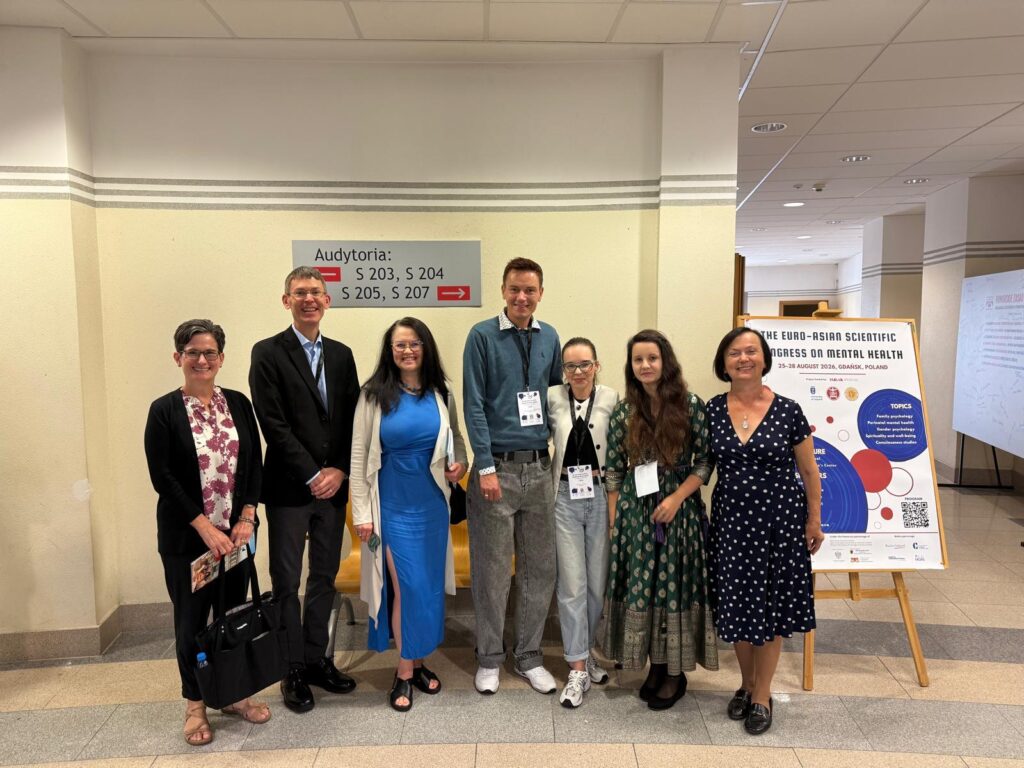
Euro-Asian Scientific Congress on Mental Health in Gdańsk
From 25 to 28 August 2026, I participated in the Euro-Asian Scientific Congress on Mental Health, held at the Faculty of Social Sciences, University of Gdańsk, Poland. The Congress was organized within the NAWA Strategic Partnerships project “Applied Social Psychology in an Intercultural Context: Synergies of UG with Vietnam” (ASPIC).
The event brought together researchers and practitioners from Europe, Asia, and North America to discuss mental health from different cultural perspectives. The scientific program covered a broad range of topics, including well-being, spirituality, family relationships, neurodiversity, perinatal psychology, and consciousness studies.
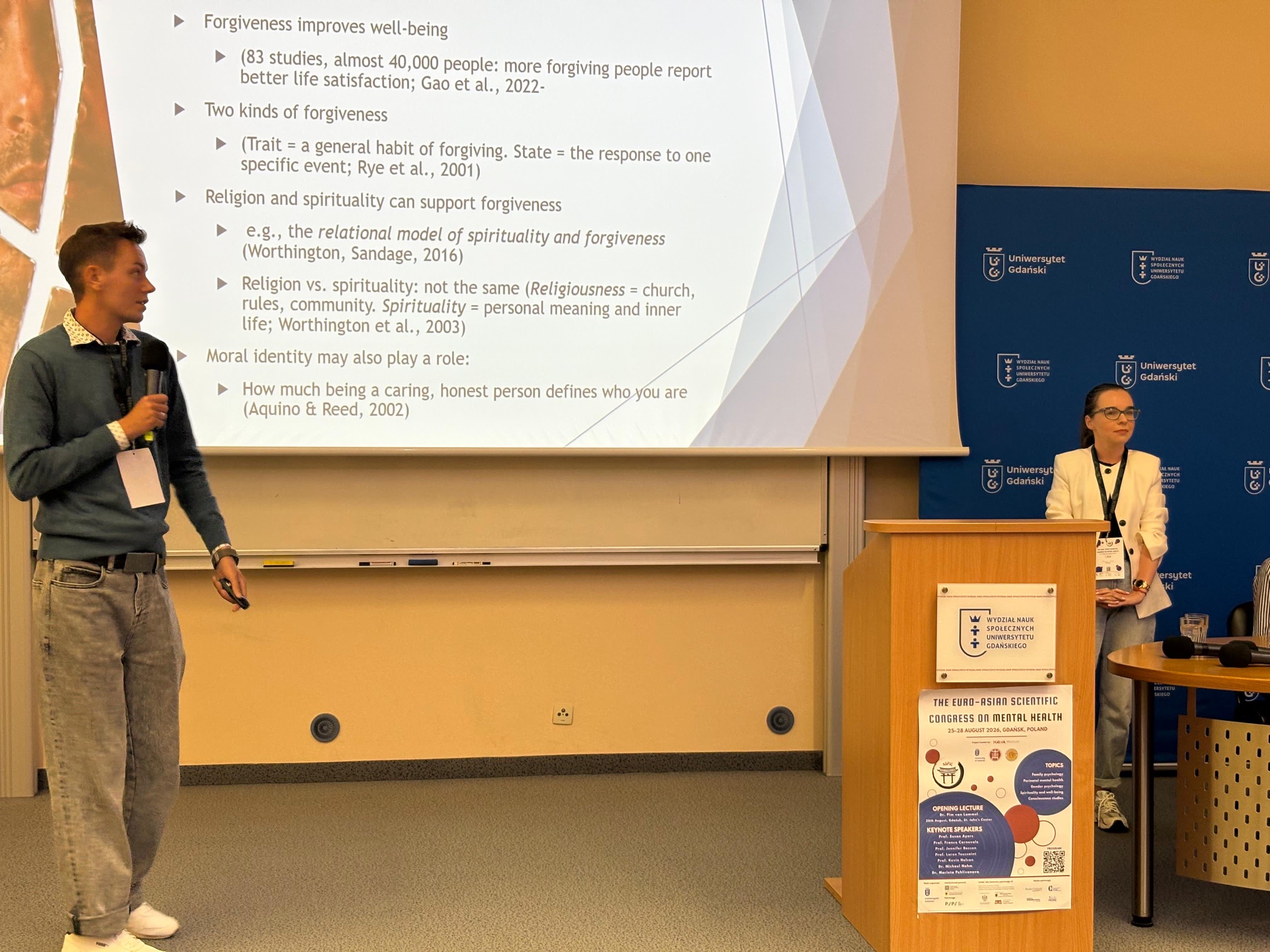
During the session “The Bright and Dark Sides of Spirituality in Mental Health,” I had the pleasure of presenting research conducted together with Patrycja Uram from the Institute of Psychology, Polish Academy of Sciences:
Age and Forgiveness: Religiousness Predicts Trait Forgiveness in Older Adults, Whereas Spirituality Is Linked to Well-Being Through State Forgiveness Across Age Groups
Across two studies with a total of 1,688 participants, we examined age differences in the relationships between religiousness, spirituality, moral identity, forgiveness, and well-being among younger (20–29 years) and older (60+ years) Polish Catholics.
Our findings showed an interesting generational difference. Religiousness predicted trait forgiveness only among older adults, whereas spirituality and moral identity were significant predictors among younger adults. At the same time, spirituality was indirectly associated with well-being through state forgiveness across age groups. This pattern may point to the changing role of traditional religiousness and more individualized forms of spirituality in how people understand and practice forgiveness.
The session was chaired by Prof. Tran Thu Huong from the University of Social Sciences and Humanities, Vietnam National University, and Dr. Edyta Charzyńska from Jagiellonian University.
I am grateful to the organizers for the opportunity to take part in this international and interdisciplinary exchange and to Patrycja Uram for our continued collaboration.
Abstract
Background: Although religiousness and spirituality (R/S) have been shown to shape forgiveness, their roles may vary across generations in the context of increasing secularization among emerging adults.
Methodology: This study examines these associations, extending them to include moral identity, in Polish Catholic samples of young (20–29) and older (60+) participants. Study 1 (N = 963) tested age differences in predictors of trait forgiveness, and Study 2 (N = 725) examined state forgiveness as a mediator of well-being.
Results: In regression analyses, with a significant interaction effect of religiousness and age, religiousness predicted trait forgiveness only in older participants, whereas spirituality and moral identity were significant predictors in young adults. In mediation analyses, despite persistent age differences in the religiousness–forgiveness link, only spirituality showed an indirect effect on well-being via state forgiveness, while moral identity was directly associated with well-being. No age-moderated mediation effect was observed.
Conclusions: Our findings suggest that, amid increasing orientation toward more individualized expressions of faith, moral identity may reflect a general sense of obligation to forgive, whereas spirituality appears more consistently associated with responses to specific transgressions through meaning-making processes independent of institutional religious practice.